
Become a Complete Developer with Python Full Stack Skills

The demand for professionals who can handle both frontend and backend development is growing rapidly. Our Python Full Stack Training in Delhi is designed to help students develop a comprehensive understanding of web development, combining programming logic with real-world application building. This course goes beyond basic coding and focuses on how complete systems are designed, developed, and deployed.

A Full Stack Python Course Delhi equips learners with the ability to work on both client-side and server-side technologies. This dual capability makes students more versatile and valuable in the job market, as companies prefer developers who can manage end-to-end development processes.

Understanding the Architecture of Full Stack Development

Full stack development is not just about learning multiple technologies; it is about understanding how different components of a web application interact with each other. Students begin by exploring the structure of web applications, including frontend interfaces, backend logic, and database management.

This Python Full Stack Developer Course with placement support emphasizes the theoretical foundation of how data flows between the user interface and the server. Understanding this architecture helps students build scalable and efficient applications while avoiding common development mistakes.

Frontend Development with Strong Conceptual Clarity

Frontend development focuses on creating the user interface and ensuring a seamless user experience. Students learn HTML, CSS, and JavaScript, which form the core technologies for building responsive and interactive web pages.

Instead of just learning syntax, students understand concepts such as layout design, responsiveness, and user interaction. This approach ensures that they can create interfaces that are not only functional but also user-friendly and visually appealing.

Backend Development Using Python and Frameworks

Backend development is where the core logic of an application resides. In this Python Full Stack Institute Delhi, students learn how to build server-side applications using Python and frameworks like Django.

The focus is on understanding how servers process requests, manage data, and communicate with the frontend. Students also learn about routing, authentication, and handling user data securely. This theoretical understanding ensures they can build robust and secure applications.

Database Management and Data Handling

A critical aspect of full stack development is managing data efficiently. Students learn how databases work, including concepts such as data storage, retrieval, and relationships between different data entities.

The course introduces both relational and non-relational databases, helping students understand when to use each type. This knowledge is essential for building applications that handle large volumes of data efficiently.

API Development and Integration

Modern applications rely heavily on APIs to communicate between different systems. Students learn how to create and integrate APIs, allowing applications to exchange data seamlessly.

Understanding APIs from a theoretical perspective helps students grasp how different services interact, which is crucial for building scalable and modular applications. This knowledge is particularly valuable in real-world development environments.

Project-Based Learning for Practical Understanding

While theory forms the backbone of this course, practical application ensures mastery. Students work on projects such as dynamic websites, e-commerce platforms, and web applications that simulate real-world scenarios. These projects help in:

  • Applying theoretical concepts in practical situations
  • Building a strong portfolio
  • Gaining confidence in development skills

By working on complete applications, students understand the entire development lifecycle.

Career Opportunities After Python Full Stack Training

Completing Python Full Stack Training in Delhi opens up multiple career opportunities. Students can apply for roles such as Full Stack Developer, Web Developer, and Backend Developer.

The demand for full stack developers is high because they can handle multiple aspects of development. This versatility increases employability and provides better career growth opportunities.

Importance of Learning from a Python Full Stack Institute Delhi

A structured learning environment plays a crucial role in mastering full stack development. At a professional Python Full Stack Institute Delhi, students receive guided learning, mentorship, and continuous feedback.

This ensures that they not only learn technologies but also understand how to apply them effectively. The structured approach reduces confusion and accelerates the learning process.

Student-Centric Approach to Learning

The course is designed to be accessible and engaging for students from all backgrounds. Complex concepts are explained in simple terms, and regular doubt-solving sessions ensure clarity.

Interactive learning methods, practical exercises, and flexible schedules make the course suitable for both students and working professionals. This student-focused approach enhances learning outcomes and builds confidence.

Building Long-Term Career Growth

The goal of this training is not just to teach tools but to develop a mindset that supports continuous learning. Technology evolves rapidly, and a strong foundation helps students adapt to new tools and frameworks.

By mastering both frontend and backend concepts, students are prepared for long-term success in the tech industry.
Python Fullstack Course Syllabus

  • Why do we need Python?
  • Environment Setup
  • Python Installation
  • Execution Types
  • What is an interpreter?
  • Interpreters vs Compilers
  • Using the Python Interpreter
  • Interactive Mode
  • Running python files
  • Working with Python shell
  • Integrated Development Environments (IDES)
  • Interactive Mode Programming
  • Script Mode Programming

Basic Operators in Python

  • Types of Operator
  • Python Arithmetic Operators
  • Python Comparison Operators
  • Python Assignment Operators
  • Python Bitwise Operators
  • Python Logical Operators
  • Python Membership Operators
  • Python Identity Operators
  • Python Operators Precedence

Basic Concepts

  • Data Types
  • Variables
  • Assigning Values to Variables
  • Multiple Assignment
  • Python Numbers
  • Python Strings
  • Accessing Values in Strings
  • String Special Operators
  • String Formatting Operator
  • Triple Quotes
  • Builtin String Operations
  • Python Lists
  • Accessing Values in Lists
  • Updating Lists
  • Delete List Elements
  • Basic List Operations
  • Indexing, Slicing, and Matrixes
  • Builtin List Functions & Methods
  • Python Tuples
  • Accessing Values in Tuples
  • Updating Tuples
  • Delete Tuple Elements
  • Basic Tuples Operations
  • Indexing, Slicing, and Matrixes
  • No Enclosing Delimiters
  • Builtin Tuple Functions
  • Python Dictionary
  • Accessing Values in Dictionary
  • Updating Dictionary
  • Delete Dictionary Elements
  • Properties of Dictionary Keys
  • Builtin Dictionary Functions & Methods

Loops and Decision Making

  • if statements
  • else statements
  • nested if statements
  • while loop
  • for loop
  • nested loops

Loop Control Statements

  • break statement
  • continue statement
  • pass statement

Functions

  • Defining a Function
  • Syntax
  • Calling a Function
  • Pass by reference vs value
  • Function Arguments
  • Required arguments
  • Keyword arguments
  • Default arguments
  • Variablelength arguments
  • The return Statement
  • Scope of Variables

Global vs. Local variables

  • Global vs. Local variables
  • Os module
  • mkdir()
  • chdir()
  • getcwd()
  • rmdir()
  • listdir()
  • Math module and functions
  • Constants
  • Trigonometry
  • Logarithmic
  • Representation
  • Random module and functions
  • random()
  • randint()
  • randrange()
  • choice()
  • shuffle()

Python Modules and Packages

Framework vs Packages

  • Folium Introduction
  • Why are modules used?
  • Creating modules
  • The import Statement
  • The from...import Statement
  • Locating Modules
  • The PYTHONPATH Variabl
  • Namespaces and Scoping
  • The dir() Function
  • The globals() and locals() Functions
  • The reload() Function
  • Packages in Python
  • Constructing user defined packages
  • Importing user defined packages

Basic OOPs Concept

  • Creating class in Python
  • Private Identifier
  • Constructor
  • Destructor
  • Inheritance
  • Polymorphism
  • Encapsulation
  • Abstraction

Decorator, Iterator and Generator Anonymous

Function

  • Lambda
  • Map
  • Filter
  • Reduce

File Manipulation

  • Opening Text File
  • The open function
  • File modes
  • The file object attributes
  • close() method
  • write() method
  • read() method
  • Files: Input
  • Files: Output
  • Reading files
  • Renaming & deleting files
  • Writing into a file
  • remove() method

Python GUI

  • Basic Operations using Tkinter
  • Buttons and Textbox
  • Menu Bar
  • Message Box and Radio Button
  • Checkbox and Event Creating
  • Creating Application in GUI
  • SQL and Python
  • Overview of MySql
  • Integrating Python with MySql
  • Project Demonstration Tkinter
  • Project Demonstration Tkinter

Other Concepts

  • Errors and Exception Handling
  • Standard exceptions
  • Assertions in Python
  • The assert Statement
  • What is Exception?
  • Handling an exception
  • Syntax
  • The except Clause with No Exceptions
  • The except Clause with Multiple Exceptions
  • The tryfinally Clause
  • Argument of an Exception
  • Example with Tkinter Application
  • Regular Expression
  • Advanced Concept Overviews
  • Basics of Pandas and Numpy
  • How to use Anaconda
  • How to create dashboard
  • Overview of Django
  • Django Course Syllabus

SECTION I

1. Introduction to Django

  • What Is a Web Framework?
  • The MVC Design Pattern
  • Django’s History

2. Installation of Django

  • Installing Python
  • Installing Django
  • Setting Up a Database
  • Starting a Project
  • The Development Server
  • Django Commands Overview

3. The Basics of Dynamic Web Pages

  • Your First View: Dynamic Content
  • Mapping URLs to Views
  • How Django Processes a Request
  • URL configurations and Loose Coupling
  • 404 Errors
  • Your Second View: Dynamic URLs
  • A Word About Pretty URLs
  • Wildcard URL patterns
  • Django's Pretty Error Pages

4. The Django Template System

  • Template System Basics
  • Using the Template System
  • Creating Template Objects
  • Rendering a Template
  • Multiple Contexts, Same Template
  • Context Variable Lookup
  • Playing with Context Objects
  • Basic Template Tags and Filters Tags
  • Philosophies and Limitations
  • Using Templates in Views
  • Template Loading
  • Render_to_response()
  • The locals() Trick
  • Subdirectories in get_template()
  • The include Template Tag
  • Template Inheritance

5. Interacting with a Database: Models

  • The "Dumb" Way to Do Database Queries in Views
  • The MTV Development Pattern
  • Configuring the Database
  • Your First App
  • Defining Models in Python
  • Your First Model
  • Installing the Model
  • Basic Data Access
  • Adding Model String Representations
  • Inserting and Updating Data
  • Selecting Objects
  • Filtering Data
  • Retrieving Single Objects
  • Ordering Data
  • Chaining Lookups
  • Slicing Data
  • Deleting Objects
  • Making Changes to a Database Schema
  • Adding Fields
  • Removing Fields
  • Removing Many to Many Fields
  • Removing Models

6. The Django Administration Site

  • Activating the Admin Interface
  • Using the Admin Interface
  • Users, Groups and Permissions
  • Customizing the Admin Interface
  • Customizing the Admin Interface’s Look and Feel
  • Customizing the Admin Index Page
  • When and Why to Use the Admin Interface

SECTION II

7. Form Processing

  • Search
  • The "Perfect Form"
  • Creating a Feedback Form
  • Processing the Submission
  • Custom Validation Rules
  • A Custom Look and Feel
  • Creating Forms from Models

8. Advanced Views and URL configurations

  • URL configuration Tricks
  • Streamlining Function Imports
  • Using Multiple View Prefixes
  • SpecialCasing URLs in Debug Mode
  • Using Named Groups
  • Understanding the Matching/Grouping Algorithm
  • Passing Extra Options to View Functions
  • Using Default View Arguments
  • SpecialCasing Views
  • Capturing Text in URLs
  • Determining What the URL configuration Searches Against
  • Including Other URL configurations
  • How Captured Parameters Work with include()
  • How Extra URL configuration Options Work with include()
  • Section II: Django Sub Framework

9. Generic Views

  • Using Generic Views
  • Generic Views of Objects
  • Extending Generic Views
  • Making "Friendly" Template Contexts
  • Complex Filtering with Wrapper Functions
  • Performing Extra Work

10. Extending the Template Engine

  • Template Language Review
  • Request Context and Context Processors
  • django.core.context_processors.auth
  • django.core.context_processors.request
  • Guidelines for Writing Your Own Context Processors
  • Inside Template Loading
  • Extending the Template System
  • Creating a Template Library
  • Writing Custom Template Filters
  • Writing Custom Template Tags

11. Users and Registration

  • Cookies
  • Getting and Setting Cookies
  • The Mixed Blessing of Cookies
  • Setting Test Cookies
  • Users and Authentication
  • Enabling Authentication Support
  • Using Users
  • Logging In and Out
  • Limiting Access to Logged-in Users
  • Managing Users, Permissions and Groups
  • Using Authentication Data
  • Permissions
  • Groups
  • Messages
  • Profiles

12. Core Steps for Building a Django API

  • Set Up the Environment
  • Configure Project Settings
  • Define Models
  • Creating Serializers
  • Define Views
  • Set Up URLs
  • Test the API using Postman
Youtube Thumbnail

Helpful Frequently Asked Questions (FAQs)

What is full stack development?+
Is this course suitable for beginners?+
What technologies will I learn?+
Will I work on real-world projects?+
Is certification provided after completion?+
Will I get placement support?+

Discover Your Ideal Course Now!

Take the next step in your career with the right choice. Explore our industry focused courses, learn practical skills, and get closer to your dream job with expert guidance and real projects.

Register Now

Trusted by Companies, Proven by Placements

Join thousands of students who’ve launched successful careers with top employers.


Hear from Our Successful Students

Our students turned dreams into achievements! From first steps to big wins, their journeys inspire confidence, growth, and success. Hear how dedication and guidance made it all possible.


loader

Start Learning With CodeSquadz

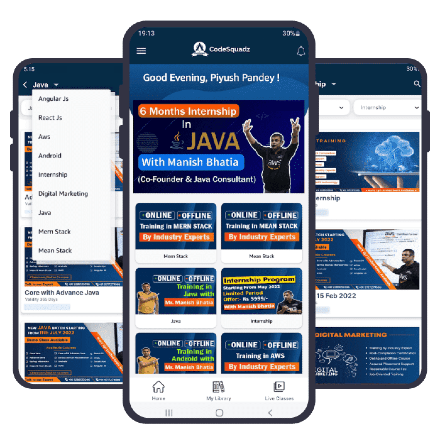
Download Our App

The more you explore, the more you enhance your skills and head towards a successful IT career. Go and download our Android / Windows app and access our lessons to practice and interactive quizzes; this application provides an effective way to learn and sharpen your IT skills to advance your career.

app-edu-android-app app-edu-windows-app
codesquadz-app