

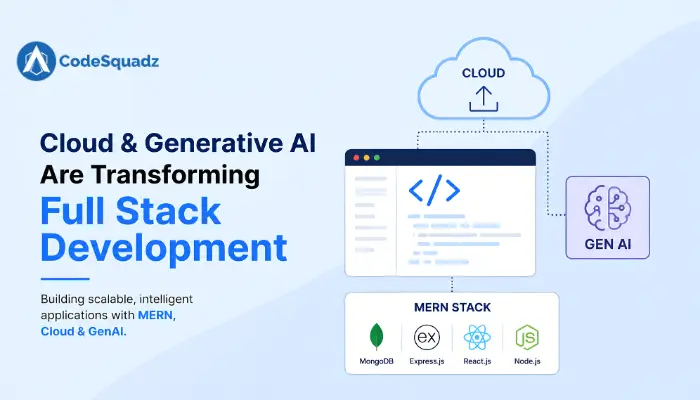
Full-stack development is moving beyond traditional frontend and backend coding. Modern applications need to handle changing traffic, operate reliably in the cloud, and provide smarter experiences for users. This is where MERN stack development, cloud computing, and Generative AI come together. MERN provides the core technologies for building web applications, cloud platforms provide infrastructure for deployment and scalability, and Generative AI enables intelligent features. For students and aspiring developers, understanding this combination provides a view of modern software development and helps them build applications that are more practical, scalable, and relevant to current industry requirements.
Understanding MERN Stack Development
MERN is a JavaScript-based technology stack used to build full-stack web applications. It includes MongoDB, Express.js, React.js, and Node.js. MongoDB manages application data, Express.js supports backend development and APIs, React.js supports interactive user interfaces, and Node.js runs JavaScript on the server. A MERN stack developer can work across frontend and backend development while using JavaScript across most parts of the application. This makes MERN a practical choice for students who want to learn full-stack development and understand how different application components work together.
However, modern development goes beyond writing and testing code. Once a MERN application is ready, it needs to be hosted, secured, monitored, and scaled based on user requirements. Cloud computing provides the infrastructure required for deployment, storage, databases, security, and scalability without relying entirely on physical servers.
Generative AI adds another layer by enabling features such as chatbots, content generation, recommendations, and intelligent assistance. For example, an online learning platform can use MERN to manage its frontend, backend, and database, cloud services to host the application, and Generative AI to answer student questions or summarize lessons.
The combination of MERN stack development, cloud computing, and Generative AI allows developers to build applications that are scalable, intelligent, and better suited to modern user needs.
The Role of Cloud Computing in MERN Development
Cloud computing provides developers with access to computing resources, databases, storage, networking, security, and monitoring through internet-based platforms. For MERN developers, this means an application developed on a local computer can eventually be deployed to infrastructure that supports real users. Cloud resources can also be adjusted according to application requirements. For example, an e-commerce application may experience higher traffic during a sale. Cloud infrastructure can help support these changing demands while providing tools for monitoring application performance and managing resources more efficiently.
AWS is one of the widely used cloud platforms for application development and deployment. AWS training can help developers understand cloud concepts such as computing, storage, databases, networking, security, and monitoring. A MERN developer does not need to become a cloud architect, but basic cloud knowledge can make their development skills more complete. Understanding deployment also helps developers identify problems that may not appear during local development, including configuration errors, resource limitations, security concerns, and performance issues. This knowledge can be especially useful for students preparing to work on applications beyond a classroom environment.
How Generative AI Is Changing Full Stack Applications
Generative AI allows applications to generate content, answer questions, summarize information, and provide intelligent assistance based on user input. MERN applications can integrate these capabilities through AI APIs. For example, a React interface can collect a user’s question and send it to a Node.js backend. The backend can communicate with an AI service, process the response, and return the result to the React application. This architecture connects frontend development, backend programming, cloud infrastructure, and AI services. Developers can therefore build applications that do more than display stored information and instead provide interactive, intelligent experiences based on user needs.
Generative AI is also becoming useful as a development assistant. Developers can use AI tools to understand unfamiliar code, generate suggestions, identify possible bugs, create documentation, and develop basic test cases. For students, this can make learning and experimentation easier when used responsibly. However, AI-generated code should always be reviewed and tested before being used in an application. Developers need programming knowledge to understand whether the generated solution is correct, secure, and suitable. Therefore, learning AI does not remove the need for coding fundamentals. Instead, it gives developers another tool that can support problem-solving and development.
Practical Use Cases of MERN, Cloud, and Generative AI
The combination of MERN, cloud computing, and Generative AI can be applied to several real-world applications. An online education platform can use MERN to manage courses and users, cloud services to host the application, and AI to answer questions or summarize lessons. An e-commerce platform can use AI for product recommendations and conversational search. Customer support systems can combine MERN interfaces with AI-powered responses. Content platforms can use AI to create summaries and descriptions. Business dashboards can also use Generative AI to explain large amounts of information. These examples show how developers can combine different technologies to solve specific application requirements.
A typical deployment process starts with developing and testing the MERN application locally. The code can then be stored in a Git repository, tested, built, and deployed to cloud infrastructure. A simplified workflow is Development → Git → Testing → Build → Cloud Deployment → Monitoring. Depending on the architecture, frontend and backend components may be deployed separately, while databases can use managed cloud services. Developers should also understand environment variables, authentication, API security, and monitoring. As applications grow, additional concepts such as caching, containers, load balancing, and automated deployment may become useful for improving reliability and performance.
Skills Required to Become a Modern MERN Developer
If you are wondering how to become a MERN stack developer, start with HTML, CSS, and JavaScript fundamentals. Then learn React.js for frontend development and Node.js, Express.js, and MongoDB for backend development. After building a strong MERN foundation, learn REST APIs, authentication, Git, and deployment. You can then explore cloud platforms such as AWS and learn how AI and APIs can be integrated into applications. This step-by-step approach helps beginners learn each technology properly and understand how different components work together to build complete web applications.
Hands-on practice is equally important. Start by building a simple MERN application, such as a task manager, blog, or learning platform. Once it works locally, deploy it to the cloud to understand hosting and deployment. You can then add an AI feature, such as a chatbot, summarizer, or recommendation system. Building these applications helps students apply their knowledge and solve practical problems involving APIs, databases, authentication, deployment, and performance. This experience can strengthen technical skills and provide a better understanding of how modern applications are developed and maintained
Why Cloud and Generative AI Skills Matter for MERN Developers
MERN continues to provide a useful foundation for web development, but modern developers often work across a wider technology environment. Cloud knowledge helps developers understand hosting, scalability, security, and monitoring, while Generative AI knowledge allows them to build intelligent features and use AI tools during development. Developers do not need to become specialists in every field. Instead, they should understand enough to select appropriate technologies and connect them effectively. For students, combining MERN with cloud and AI can also make learning more practical because they can see how frontend, backend, infrastructure, and intelligent services work together.
When choosing a MERN stack course, students should look beyond programming syntax. A useful course should cover frontend development, backend development, databases, APIs, authentication, version control, and deployment. Exposure to cloud computing and Generative AI can provide additional value for learners interested in modern application development. Practical training is particularly important because students gain experience by building and troubleshooting applications rather than only studying concepts. Mentorship, hands-on learning, interview preparation, and placement assistance can also provide useful support while learners prepare for software development careers and work toward becoming more confident full-stack developers.
How CodeSquadz Can Help
CodeSquadz focuses on practical and industry-relevant technology training for students and aspiring professionals. Learners interested in MERN can strengthen their frontend and backend development skills while gaining exposure to modern development practices. Students can also explore cloud computing and Generative AI concepts to understand how these technologies can work with full-stack applications. The learning process should focus on understanding requirements, developing solutions, testing applications, and learning deployment practices. With practical training, mentorship, hands-on exposure, interview preparation, and placement assistance, students can build a stronger foundation for pursuing opportunities in software development.
Future of Full Stack Development
The future of full stack development is likely to involve closer integration between programming, cloud computing, automation, and AI. Developers may use AI tools to support coding, testing, documentation, and debugging while also building AI-powered features for end users. However, strong programming fundamentals will remain important because developers must evaluate generated code, understand application architecture, identify errors, and make technical decisions. Students can prepare by learning MERN thoroughly and then adding cloud and Generative AI skills. Building and deploying practical applications can help them understand how modern software is created, maintained, improved, and delivered to users.
Conclusion
MERN stack development provides a strong foundation for creating modern web applications, while cloud platforms support deployment, scalability, security, and monitoring. Generative AI adds intelligent capabilities that can improve user experiences and support developers during the software development process. Students can begin with JavaScript and core MERN technologies before gradually learning cloud computing and AI integration. The most effective approach is to learn through practical applications, deploy those applications, and understand how different technologies work together. By developing these complementary skills, aspiring developers can build a broader understanding of modern software development and prepare for changing industry requirements.
FAQs
1. What is MERN stack development?
MERN stack development uses MongoDB, Express.js, React.js, and Node.js to create full-stack web applications. Developers can use these technologies to build interfaces, backend services, APIs, databases, authentication systems, and application logic. MERN is popular because JavaScript can be used across multiple parts of the application.
2. What does a MERN stack developer do?
A MERN stack developer builds web applications using React, Node.js, Express.js, and MongoDB. They handle frontend, backend, databases, APIs, authentication, testing, and deployment, often integrating cloud and AI services.
3. How to become a MERN stack developer?
Learn HTML, CSS, and JavaScript first. Then move to React.js, Node.js, Express.js, and MongoDB. After understanding the core stack, learn APIs, authentication, Git, and deployment. You can then add cloud computing and Generative AI skills to build more advanced and practical applications.
4. Why should MERN developers learn AWS?
AWS knowledge helps MERN developers understand how applications are hosted and managed in cloud environments. It introduces concepts such as computing, storage, databases, networking, security, scalability, and monitoring. These skills can help developers move beyond local development and understand how applications operate in production environments.
5. How can Generative AI be integrated with MERN?
Generative AI can be integrated through APIs. A React frontend collects user input, while a Node.js backend communicates with an AI service. The backend processes the response and sends it back to the frontend. This approach can support chatbots, summarization, recommendations, content assistance, and other intelligent features.
6. Is MERN still useful with Generative AI?
Yes. MERN remains useful for building modern web applications, while Generative AI adds intelligent features such as chatbots, recommendations, and content generation. Therefore, combining MERN with cloud and AI skills can help developers build more advanced applications.