

In today’s technology-driven world, businesses rely heavily on web applications to deliver seamless digital experiences. From e-commerce platforms and banking applications to healthcare systems and enterprise software, organizations need developers who can build complete applications from the user interface to the server and database. This growing demand has made Full Stack Development one of the most sought-after career paths, and Java continues to be one of the most trusted technologies for building scalable and secure applications.
If you’re planning to start a career in software development, you may have come across terms like Full Stack Developer, Java Developer, or Java Full Stack Developer. But what is Java Full Stack, and why is it considered one of the best career choices for aspiring developers?
This guide will help you understand everything about Java Full Stack development, including the technologies involved, the learning roadmap, skills required, career opportunities, and how enrolling in a Java full stack development course can help you become an industry-ready professional.
What Is Java Full Stack?
To understand what full-stack Java is, let’s first break the term into two parts.
Java is a powerful, object-oriented programming language widely used for developing enterprise applications, web applications, mobile applications, and cloud-based solutions. It is known for its platform independence, security, scalability, and reliability.
Full Stack refers to the ability to develop both the frontend and backend of a web application.
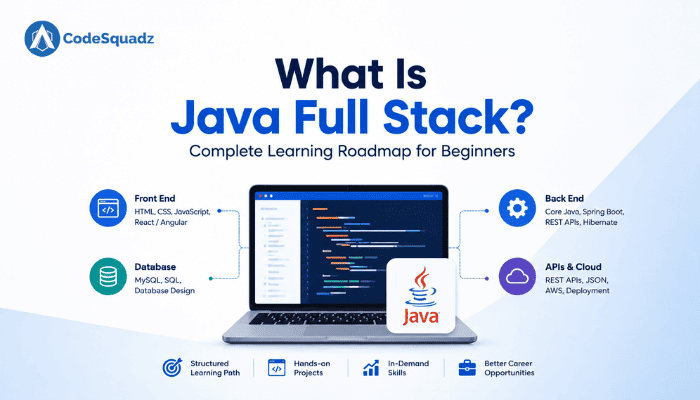
A Java Full–stack Developer is a professional who can build an entire web application using Java for backend development while also working with frontend technologies like HTML, CSS, JavaScript, React, or Angular. In addition, they manage databases, APIs, version control, deployment, and application integration.
Instead of specializing in only one area, a Full Stack Java Developer understands the complete software development lifecycle, making them highly valuable to employers across industries.
Why Is Java Full-stack So Popular?
Technology trends evolve rapidly, but Java has remained one of the most preferred programming languages for more than two decades. Large enterprises, startups, government organizations, financial institutions, and healthcare companies continue to rely on Java because of its stability and performance.
Learning Java full-stack programming gives students an advantage because they acquire multiple skills instead of focusing on a single technology.
- High demand across industries
- Excellent career growth opportunities
- Strong community support
- Platform-independent development
- Enterprise-level security
- Scalability for large applications
- Excellent salary packages
- Continuous industry adoption
Some key reasons behind its popularity include:
Because Java powers thousands of enterprise applications worldwide, professionals with Full Stack Java skills remain in demand regardless of market trends.
What Does a Java FullStack Developer Do?
A Java full-stack Developer works on every layer of an application, from designing attractive user interfaces to developing secure backend systems.
Some of the key responsibilities include:
- Creating responsive web pages
- Developing backend business logic
- Building RESTful APIs
- Managing relational databases
- Integrating frontend and backend
- Writing reusable code
- Testing and debugging applications
- Deploying applications on cloud platforms
- Maintaining application performance
- Implementing security best practices
This versatility allows Full Stack Developers to contribute throughout the development lifecycle rather than working on only one component of a project.
Technologies Used in Java Full Stack Development
One of the biggest advantages of learning Java Full Stack is exposure to multiple technologies that are widely used in the software industry.
Frontend Technologies
The frontend is everything users interact with directly. It focuses on creating responsive, visually appealing, and user-friendly interfaces.
Frontend technologies typically include:
- HTML5
- CSS3
- JavaScript
- Bootstrap
- React
- Angular
These technologies help developers create websites and web applications that work smoothly across desktops, tablets, and smartphones.
Backend Technologies
The backend manages the business logic of an application. It processes requests, communicates with databases, and ensures secure data handling.
Common backend technologies include:
- Core Java
- Advanced Java
- Spring Framework
- Spring Boot
- Spring MVC
- Hibernate
- REST APIs
Among these, Spring Boot has become the industry standard because it simplifies enterprise application development and significantly reduces development time.
Database Technologies
Every web application requires a database to store and retrieve information.
Java developers generally work with:
- MySQL
- PostgreSQL
- Oracle Database
- MongoDB
Learning SQL, database design, indexing, and query optimization is an essential part of becoming a Full Stack Java Developer.
Development Tools
Modern software development also involves several tools that improve productivity.
These include:
- Git
- GitHub
- Maven
- Gradle
- Postman
- IntelliJ IDEA
- Eclipse
- Visual Studio Code
Employers expect developers to be comfortable using these tools while working in collaborative environments.
Skills Required to Become a Java Fullstack Developer
Success in Full Stack Development goes beyond learning programming languages. Employers look for professionals who can solve problems, write efficient code, and collaborate effectively within development teams.
Some of the most important technical skills include:
- Object-Oriented Programming
- Data Structures and Algorithms
- HTML and CSS
- JavaScript
- SQL
- Java Programming
- Spring Boot
- Hibernate
- REST API Development
- Version Control using Git
- Database Management
- Cloud Fundamentals
- Debugging Techniques
- Application Deployment
Soft skills also play an important role. Communication, analytical thinking, teamwork, adaptability, and problem-solving abilities help developers perform better in real-world projects and interviews.
Java Full Stack Developer Learning Roadmap
Many beginners feel overwhelmed because Java Full Stack covers multiple technologies. The good news is that learning becomes much easier when you follow a structured roadmap.
The journey usually begins with Core Java, where you learn programming fundamentals such as variables, loops, functions, classes, objects, inheritance, polymorphism, exception handling, collections, and multithreading. Building a strong Java foundation is essential because every advanced framework depends on these concepts.
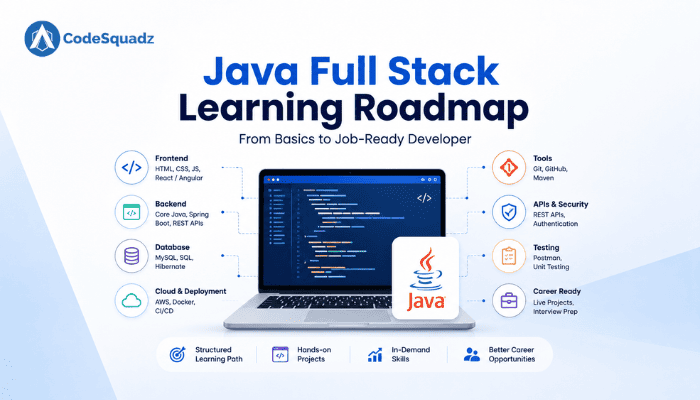
Once you’re comfortable with Java, the next step is learning database management. Understanding SQL, CRUD operations, joins, normalization, and relational database concepts prepares you to build applications that store and retrieve information efficiently.
After databases, focus on frontend development by learning HTML, CSS, JavaScript, Bootstrap, and a modern JavaScript framework such as React or Angular. These technologies help you create responsive and interactive user interfaces.
The next phase involves Advanced Java concepts like Servlets, JSP, JDBC, and session management before moving to Spring Framework and Spring Boot, which simplify enterprise application development.
Finally, learn REST API development, Git, Maven, deployment, Docker basics, and cloud platforms like AWS to become completely industry-ready.
Java Fullstack Developer Syllabus
A structured Java full-stack developer syllabus is designed to help students gradually master both frontend and backend development. Most industry-oriented training programs include the following modules:
Core Java
This module builds the programming foundation by covering:
- Variables and Data Types
- Operators
- Conditional Statements
- Loops
- Arrays
- Methods
- Classes and Objects
- Constructors
- Inheritance
- Polymorphism
- Encapsulation
- Abstraction
- Exception Handling
- Collections Framework
- Multithreading
- File Handling
A strong understanding of Core Java enables students to learn advanced frameworks with confidence.
Frontend Development
Frontend development focuses on creating responsive and interactive user interfaces using modern web technologies.
Students typically learn:
- HTML5
- CSS3
- JavaScript
- Bootstrap
- Responsive Web Design
- React or Angular
These technologies allow developers to build attractive websites that provide a seamless user experience across different devices.
Database Management
Almost every web application relies on databases to store and manage information. This module introduces students to:
- SQL Fundamentals
- MySQL
- CRUD Operations
- Joins
- Indexes
- Views
- Stored Procedures
- Database Design
- Normalization
Database knowledge is essential for developing scalable and data-driven applications.
Advanced Java
After mastering Core Java, students move to advanced concepts required for enterprise applications.
Topics include:
- JDBC
- Servlets
- JSP
- Session Management
- Cookies
- Filters
- MVC Architecture
These concepts help developers understand how web applications process client requests and generate dynamic responses.
Spring Framework and Spring Boot
Spring has become the industry standard for Java application development.
Students learn:
- Spring Core
- Dependency Injection
- Spring MVC
- Spring Boot
- Spring Data JPA
- Hibernate
- Spring Security
Spring Boot simplifies application development by reducing configuration efforts and improving productivity.
REST API Development
Modern applications communicate through APIs. Every Java Fullstack Developer should understand how to:
- Create RESTful APIs
- Handle HTTP Requests
- Exchange JSON Data
- Test APIs using Postman
- Secure APIs with Authentication
API development is one of the most valuable skills employers expect from Full Stack Developers.
Version Control and Build Tools
Professional software development requires collaboration and efficient project management.
Students learn:
- Git
- GitHub
- Maven
- Gradle
These tools help manage source code, dependencies, and project versions.
Cloud and Deployment Basics
Today’s applications are commonly deployed on cloud platforms. Basic deployment knowledge improves employability and prepares students for real-world development environments.
Topics generally include:
- Apache Tomcat
- Docker Basics
- AWS Fundamentals
- CI/CD Introduction
- Application Deployment
Projects Every Beginner Should Build
Practical experience is just as important as theoretical knowledge. Recruiters often evaluate candidates based on the projects they have completed.
Some recommended beginner projects include:
- Student Management System
- Employee Management Portal
- Online Food Ordering System
- Hospital Management System
- Banking Application
- E-commerce Website
- Library Management System
Working on real-world projects helps students understand application architecture, debugging techniques, and software deployment while building a strong portfolio.
Career Opportunities After Learning Java Full Stack
One of the biggest advantages of learning Java full-stack is the wide variety of career opportunities available across industries.
Companies in banking, finance, healthcare, education, retail, logistics, telecommunications, and software development actively hire professionals with Full Stack Java skills.
Some popular job roles include:
- Java Full Stack Developer
- Java Developer
- Software Engineer
- Backend Developer
- Web Application Developer
- API Developer
- Spring Boot Developer
- Software Consultant
- Cloud Application Developer
- Technical Analyst
Because Full Stack Developers understand both frontend and backend technologies, they often have better career flexibility than professionals specializing in a single domain.
Salary of a Java Full Stack Developer
Salary varies based on technical expertise, project experience, company, and location. However, it remains one of the most rewarding technology domains.
Typical salary ranges in India are:
- Freshers: ₹4 LPA to ₹7 LPA
- 2 to 4 Years Experience: ₹7 LPA to ₹12 LPA
- 5+ Years Experience: ₹12 LPA to ₹20 LPA or more
Professionals skilled in Spring Boot, Microservices, Cloud Computing, DevOps, and modern frontend frameworks often receive higher salary packages.
Why Choose a Java Fullstack Development Course?
Learning independently is possible, but a structured Java fullstack development course provides a clear roadmap, expert mentorship, practical assignments, and real-world exposure.
A quality training program helps students:
- Learn in a structured sequence
- Build live industry projects
- Receive mentorship from experienced trainers
- Improve coding and problem-solving skills
- Prepare for technical interviews
- Build a professional portfolio
- Gain placement assistance
This significantly reduces the learning curve and helps students become job-ready faster.
Is Java Fullstack a Good Career in 2026 and Beyond?
Absolutely. Despite the emergence of newer programming languages and frameworks, Java continues to dominate enterprise software development. Organizations continue to invest in Java because of its stability, security, scalability, and extensive ecosystem.
As businesses increasingly adopt cloud computing, digital transformation, and enterprise automation, the demand for Full Stack Java Developers is expected to remain strong for years to come.
For students looking for a future-proof career with excellent growth opportunities, Java FullStack is an excellent choice.
Frequently Asked Questions
What is Java Fullstack?
It refers to developing both the frontend and backend of a web application using Java along with technologies like HTML, CSS, JavaScript, React or Angular, Spring Boot, databases, and REST APIs.
What is Full Stack Java used for?
It is used to build complete web applications, enterprise software, banking systems, healthcare platforms, e-commerce websites, and cloud-based business applications.
Is Java Full Stack difficult for beginners?
No. With a structured learning approach and regular practice, beginners can successfully learn Java Full Stack even without prior programming experience.
How long does it take to learn Java Full Stack?
Most students become job-ready within 5 to 8 months through consistent learning, practical assignments, and live project experience.
Which is better, Java Full Stack or Python Full Stack?
Both have excellent career opportunities. Java Full Stack is widely preferred for enterprise applications, while Python is popular for startups, automation, and AI-related projects. The right choice depends on your career goals.
Conclusion
Understanding what Java Full Stack is is the first step toward building a successful career in software development. A Java Full Stack Developer possesses the skills to design responsive user interfaces, develop secure backend systems, manage databases, create APIs, and deploy applications, making them one of the most versatile professionals in the IT industry.
As businesses continue to invest in digital solutions, professionals with expertise in Java full-stack programming will remain in high demand. Whether you’re a student, graduate, or working professional looking to upskill, investing in a full–stack Java developer course can open the door to exciting career opportunities across industries.
At CodeSquadz Education, we offer industry-focused Java Full Stack Training designed to help students master the latest technologies through expert-led sessions, hands-on projects, interview preparation, certification guidance, and dedicated placement assistance. If you’re ready to build a rewarding career in software development, join CodeSquadz Education and take your first step toward becoming a confident and job-ready Java Fullstack Developer.