Table of Contents
- 1. What Is MERN Stack?
- 2. Understanding the Four MERN Technologies
- 3. How Does MERN Stack Development Work?
- 4. What makes the MERN Stack so popular?
- 5. What is the work of a MERN Stack developer?
- 6. How to Become a MERN Stack Developer
- 7. Why Projects Matter in MERN Learning
- 8. MERN Stack Developer Salary and Career Opportunities
- 9. MERN Stack in 2026
- 10. Conclusion
- 11. Frequently Asked Questions
If you are planning a career in web development, you may have heard of the MERN Stack. It combines MongoDB, Express.js, React.js, and Node.js to build modern web applications.
One key advantage of MERN is that it uses JavaScript for both frontend and backend development, making the development process easier to manage. Moreover, MERN is widely used for e-commerce websites, SaaS platforms, startups, and business applications. Learning MERN can provide a strong foundation for becoming a full-stack developer.
What Is MERN Stack?
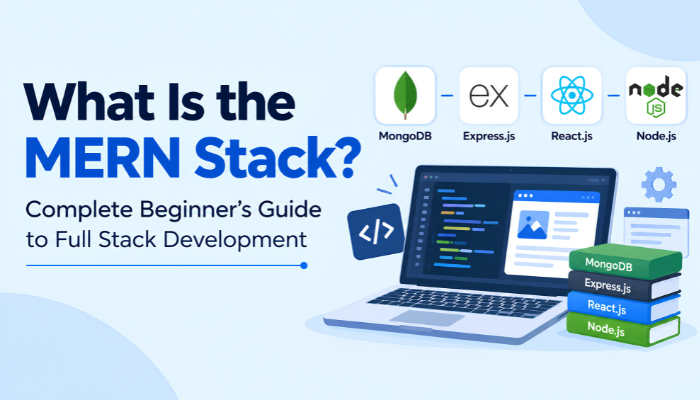
MERN Stack is a technology stack based on JavaScript and is used for creating full-stack web applications; the name MERN is derived from its four principal technologies:
1. MongoDB – Database
2. Express.js- a backend web framework
3. React.js – a frontend JavaScript library
4. Node.js is a JavaScript runtime environment.
Understanding the Four MERN Technologies
In order to understand the MERN Stack, it is necessary to know the function of each of the technologies.
1. MongoDB
MongoDB is a NoSQL database that stores data in flexible document-based formats. Different from conventional relational databases that mainly organize information in tables and rows, MongoDB uses documents similar to JSON.
2. Express.js
Express.js is a lightweight framework that is used with Node.js; it assists developers in the creation of APIs, in dealing with requests, in managing routes, and in building backend features.
For instance, Express.js can be used to handle the login request and interact with the database when a user logs into a website.
3. React.js
React.js is used for the development of the frontend or user interface of a web application and enables developers to create reusable components such as navigation bars, buttons, forms, product cards, and dashboards.
The fact that React uses a component-based method makes it simpler to develop and maintain complex user interfaces.
4. Node.js
Node.js enables JavaScript to be used outside of the browser. It is usually employed in the development of server-side applications and APIs.
Since both Node.js and React use JavaScript, programmers can use a single main programming language when working on the application.
How Does MERN Stack Development Work?
A typical MERN application functions by having communication take place between the frontend, the backend, and the database.
Imagine that a user opens a food delivery application and searches for some restaurants; React.js shows the search interface and makes a request to the backend, which is handled by Express.js, while Node.js carries out the server-side logic.
The backend then contacts MongoDB in order to get the relevant restaurant information and sends the result back to the frontend, where React.js shows it to the user.
What makes the MERN Stack so popular?
The MERN Stack has gained in popularity due to the fact that it provides a practical method for full-stack development.
Initially, developers can use JavaScript in the entire application, thus eliminating the necessity of switching between different programming languages when going from frontend to backend development.
Secondly, React.js offers reusable components, and this can lead to a more organised development process. Likewise, Node.js makes use of an event-driven architecture, which is suitable for applications that need to handle a large number of simultaneous requests.
MERN is also frequently linked with various types of applications such as SaaS platforms, e-commerce systems, dashboards, social platforms, educational applications, and business software.
What is the work of a MERN Stack developer?
The person who develops using the MERN Stack is involved in both the frontend and the backend of a web application, although the specific duties they have may differ according to the organization and the project.
A developer can create responsive interfaces with React, develop REST APIs with Node.js and Express.js, connect applications to MongoDB, implement authentication, test the APIs, fix any bugs, and deploy the applications.
A typical developer using the MERN stack will make use of tools such as Git, GitHub, REST APIs, JSON, npm, authentication systems, and cloud platforms.
The job therefore demands more than just knowledge of React and Node.js; developers have to understand how different technologies communicate with one another.
How to Become a MERN Stack Developer
1. Study HTML and CSS: make sure you understand page structure, layouts, responsive design, and basic styling.
2. Learn JavaScript by concentrating on variables, functions, arrays, objects, the DOM, ES6 and later features, asynchronous programming, promises, and APIs.
3. Learn React.js by studying components, props, state, hooks, routing, forms, and integration with APIs.
4. Study Node.js and Express.js by gaining an understanding of servers, routes, middleware, APIs, authentication, and error handling.
5. Learn MongoDB. Practice creating databases, collections, documents, queries, and CRUD operations.
6. Develop projects: Make applications that incorporate frontend, backend, and database technologies.
7. Study Git and deployment: Make sure you understand version control and how to publish applications on the internet.
Why Projects Matter in MERN Learning
One of the best methods of turning theoretical knowledge into practical development skills is through projects.
For instance, a beginner could begin by working on a simple task management application; after having understood CRUD operations, they could then proceed to a blog platform that includes authentication and comments.
They can then go on to develop more sophisticated projects, for example, an e-commerce platform, a learning management system, an appointment booking application, or a SaaS dashboard.
Projects also provide beginner developers with a practical topic they can talk about in interviews; rather than stating that they know React, they can describe how they used React, Node.js, Express.js, and MongoDB to deal with a particular problem.
MERN Stack Developer Salary and Career Opportunities
The amount that a MERN Stack developer earns varies according to their experience, place of residence, technical abilities, the company they are with, the complexity of the project, and how well they perform in the interview. Those who are just starting can take up entry-level posts, whereas more experienced developers have the opportunity to advance to senior development, technical leadership, or specialized engineering positions.
Career opportunities can include:
MERN skills can open opportunities in roles such as:
- MERN Stack Developer
- Full Stack Developer
- React Developer
- Node.js Developer
- Backend Developer
- Software Engineer
The need for web applications is still leading to a variety of opportunities in fields including fintech, healthcare, e-commerce, education, SaaS, and IT services.
MERN Stack in 2026
Will it be advisable for people beginning to learn in 2026 to study MERN?
Certainly, particularly if you want to become a full-stack web developer. However, you should learn it as a whole development skill set rather than just memorising the individual technologies.
Is the MERN Stack suitable for you?
MERN is a good option if you like creating websites, applications, user interfaces, and other interactive digital products; it is especially suitable for people who want to work with JavaScript and eventually deal with both front-end and back-end development.
Choosing a technology stack should be based on your career objectives; if you would like to become a full-stack web developer and have a preference for JavaScript, then the MERN option is worth looking into.
The first and most important thing to do is to focus on the basics, keep up with regular practice, carry out projects, and then progressively move on to more advanced development concepts.
Conclusion
To become a full-stack developer, it is important to understand how the MERN Stack—MongoDB, Express.js, React.js, and Node.js—works together to build modern web applications.
For beginners, one major advantage is that JavaScript is used across the stack, allowing developers to work on both frontend and backend features without switching between languages.
Frequently Asked Questions
1. What is a MERN Stack developer?
A MERN Stack developer is a web developer who works with MongoDB, Express.js, React.js, and Node.js to build frontend interfaces, backend services, APIs, and database-driven applications.
2. How long does it take to learn the MERN Stack?
The learning time depends on your existing programming knowledge and practice schedule. Someone with basic web development knowledge may progress faster, while a complete beginner may need several months of consistent learning and project practice.
3. What projects can I build with MERN Stack?
You can build e-commerce websites, task management systems, blogs, social platforms, booking applications, learning management systems, dashboards, and SaaS applications. Start with simple projects before moving to complex applications.
4. What is the salary of a MERN Stack developer?
MERN Stack developer salaries vary based on experience, skills, location, company, and role. Instead of relying on one fixed salary figure, candidates should focus on strong programming fundamentals, practical projects, problem-solving skills, and interview preparation.
5. Is MERN Stack still relevant in 2026?
Yes. MERN remains useful for developing modern web applications. Developers can make their skills more future-ready by combining MERN knowledge with cloud deployment, security, testing, performance optimization, and AI-powered development tools.


.png)