Table of Contents
If you are a beginner in web design, you may be confused about MERN vs . MEAN Stack. Both are popular technology stacks to build modern web applications, and both can prepare you to become a full-stack developer.
The main difference between these two is one technology: MERN uses React while MEAN uses Angular.
So which one to learn? It is contingent upon your preferred way of working, the kinds of applications you want to build, and your long-term career objectives. It’s good to understand how each stack works, what makes it useful, and what skills you need to learn before choosing a course.
In this guide, we’ll break down the difference between the MERN and MEAN Stack in simple terms so you can make a more confident decision about your learning path.
What is MERN Stack?
The MERN stack is a set of four technologies used to build full-stack web applications. This includes MongoDB, Express.js, React, and Node.js.Each technology has a specific role: Application data is stored in MongoDB. Requests on the server are handled by Express.js. The user interface is built using React. JavaScript is run on the server with Node.js.
Another reason why MERN is a popular choice for beginners is that it enables developers to use JavaScript across most of the application. Rather than juggling different programming languages for the frontend and backend, you can focus on developing your skills around one primary language.MERN is perfect for building e-commerce sites, social networking sites, dashboards, and interactive websites. React also offers flexibility to developers who are creating reusable interface components. This can be useful for managing large projects.
What Is MEAN Stack?
The MEAN Stack also combines four technologies: MongoDB, Express.js, Angular, and Node.js.Three of these technologies are the same as those in MEAN. The main difference is that Angular replaces React. Angular is a web design framework that provides a more structured approach to application development. It provides features and tools to help developers organise code, manage forms, navigate, and build complex interfaces. This structure can be helpful when you are working on larger applications that need several developers to follow the same coding practices.MEAN Stack is usually used for business apps, admin dashboards, enterprise platforms, and apps with lots of interrelated features. If you are the kind of person who likes to work in a defined framework and wants more development tools built in, you might want to check out Angular.
Difference Between MERN and MEAN Stack
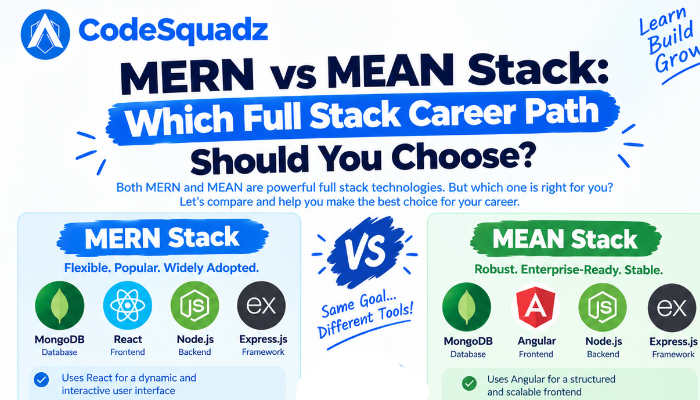
The difference between the MERN and MEAN Stack is basically in the way the front-end is developed. Both stacks use MongoDB, Express.js, and Node.js, but they have different user interface building approaches.
| Feature | MERN Stack | MEAN Stack |
| Frontend technology | React | Angular |
| Type | JavaScript library for user interfaces | Web application framework |
| Main language | JavaScript, with optional TypeScript | TypeScript is commonly used |
| Development approach | Flexible and component-based | Structured and framework-based |
| Learning experience | Often easier to start with for basic interfaces | May require learning more concepts initially |
| Common use cases | Interactive websites, startups, dashboards, e-commerce | Enterprise applications, complex dashboards, business platforms |
No stack is the best stack for all projects. The choice of a database is based on the requirements of the application, the experience of the development team, and the tools already used by the organization.
React vs Angular: What Should Beginners Know?
The main difference between these stacks is React and Angular, so knowing their approaches can make your decision easier. React is a library for building user interfaces, using reusable components. Developers have the option to add other libraries to help with things like routing and application-wide state management. That flexibility is nice, but it does mean you may have to learn how to get the different tools to work together. Angular has a more complete framework. It offers features for general development tasks and encourages developers to adhere to a consistent structure.
This is helpful when creating large applications, but there are more concepts to learn at the beginning. Suppose you are building an online shopping website. React allows you to create product cards, shopping carts, and interactive filters through reusable components. Angular can also do these features, but it also provides a more structured framework to organise a large application. Your decision shouldn’t be made based on which technology sounds more sophisticated. Try building a small project with each of them and see what development style you prefer.
Career Opportunities After Learning MERN or MEAN Stack
Both stacks will help you prepare for full-stack developer jobs. Employers are often looking for skills in frontend development, backend programming, databases, APIs, testing, and deployment—not just experience with a single stack.
Learn and explore the roles of React developer, JavaScript developer, Node.js developer, and full stack developer with MERN. MEAN can lead to Angular developer, frontend developer, Node.js developer, and full stack developer jobs.
E-commerce, finance, healthcare, education, and software services companies use web technologies to build and maintain digital products. Different teams and projects have different stacks. Salary potential varies as well. Your earning potential can be affected by where you live, how much experience you have, how well you solve problems, your project portfolio, and how well you interview. Learning a stack is a good start, but being able to build and explain real applications makes your skills more valuable.
How to Choose the Right Stack for Your Career
Before you sign up for a course, think about what you want to build and how you learn best. Both can lead to strong development skills, so find the approach that fits your goals.
Here are a few practical steps to help you decide:
Get the basics down first. Know HTML, CSS, JavaScript, programming basics, and how sites talk to servers.
Explore React and Angular. Make a small interface with each technology and see how they differ.
Choose one stack to study in depth. Don’t be the guy jumping from stack to stack. Learn the frontend, backend, database, api and deployment concepts.
Build practical projects. Create applications including a task manager, online store, and student management system.
Prepare for job opportunities. Practise debugging, git, coding interviews, and talking through the decisions you made on your projects.
The rest of the stack you can collect later. Concepts of full stack development will help you transition between similar technologies more comfortably.
Conclusion
MERN vs MEAN Stack: Your interests, learning preferences, and the type of applications you wish to develop will determine the choice.MERN uses React and is a great way to create interactive user interfaces.MEAN is built on Angular. It gives a more structured framework to develop applications.
Neither choice on its own guarantees a better job or a higher salary. Your progress depends on how well you understand the basics of programming, how much you practise solving problems, and how you apply your knowledge with projects.
If you are just starting, then don’t worry too much about which stack is more popular; learn the basics and build a strong foundation. Play around with both front-end technologies, pick the one you like, and use it often. If you have the right skills and a portfolio of meaningful projects, you can work toward a career in full-stack development.
Frequently Asked Questions
1. What is the main difference between MERN and MEAN Stack?
The difference is mostly in the frontend tech.MERN uses React; MEAN uses Angular. Both use MongoDB, Express.js, and Node.js for database and backend development. Depending on your preference for React’s flexible component-based approach or Angular’s more structured framework, you can choose between the two.
2. Is MERN Stack easier than MEAN Stack for beginners?
Some beginners find MERN easier to start with because they can begin building interfaces with React and add other tools as needed. Angular has more built-in concepts to learn initially. However, the difficulty depends on your programming background, learning style, and the complexity of the project.
3. Which stack has better career opportunities?
Both MERN and MEAN offer career opportunities in web and full-stack development. Available roles depend on employer requirements, location, experience, and current hiring needs. Rather than relying only on stack popularity, review job descriptions in your target market and build projects that demonstrate the skills employers request.
4. Can I learn MERN or MEAN Stack without prior coding experience?
Yes. Beginners can learn either stack, but it’s helpful to start with HTML, CSS, and JavaScript. You should then learn frontend development, backend concepts, databases, and APIs. Following a structured learning plan and practising through small projects can make the process easier to manage.
5. Which stack is better for large applications?
Both stacks can be used to build large applications. MEAN may appeal to teams that prefer Angular’s structured framework and built-in development features. MERN can be suitable for teams that value flexibility and React’s component-based approach. Architecture, code quality, testing, and team experience are important in either case.
6. Should I learn both MERN and MEAN Stack?
You don’t need to learn both at the beginning. Choose one stack, understand its technologies, and build a few complete projects first. After developing a solid foundation in JavaScript, databases, APIs, and web development, learning the other stack becomes more manageable and can broaden your career options.