Table of Contents
Have you ever wondered how apps stay available when thousands of people use them at the same time?
Behind every website or application, there is a team that manages the servers, automates deployments, monitors performance, and fixes problems.
This team keeps the servers running, ensures deployments go smoothly, watches performance, and solves problems quickly.
That is where AWS DevOps begins.
AWS provides cloud services that help companies build and run applications. DevOps is about making software development and deployment more reliable. Together, AWS DevOps becomes a part of modern software development.
If you want to join the IT industry learning AWS DevOps can open career chances for you.. It can be confusing to know where to start. I know how hard it can be to decide which tools to learn. Do you need to know how to program? Which certifications should you seek?
This AWS DevOps career roadmap explains the skills, tools, certifications, and hands‑on experience you should focus on to start your career in 2026.
What Is AWS DevOps?
AWS DevOps combines Amazon Web Services (AWS) with DevOps practices to help teams develop, test, deploy, and manage applications efficiently.
AWS is a cloud computing platform that offers services for computing, storage, networking, databases, security, and application management.
Instead of having to keep all their infrastructure physically, businesses can use AWS resources as they need them.
DevOps bridges the gap between development and operations teams. The main goal is to automate repetitive tasks, improve collaboration, reduce deployment errors, and deliver the software more often.
For example, suppose a company is updating its mobile application. Developers used to write the code and then pass it off to another team to deploy. This can be time-consuming and lead to communication gaps.
DevOps practices can automate a lot of the process. As developers change the code, automated tools can test the code, get the application ready, and push it to the cloud.
AWS supplies the infrastructure.
Why Learn AWS DevOps in 2026?
Cloud platforms are increasingly being used by businesses for managing applications, storing information, and supporting their digital operations. They also need professionals who can automate infrastructure and deliver software reliably.
AWS DevOps skills are useful across industries like banking, healthcare, e-commerce, education, and software development.
Here are some reasons to choose this career path:
Greater use of cloud computing: Firms are adopting cloud platforms to maintain infrastructure without relying solely on physical servers.
Faster software delivery: CI/CD practices enable teams to test and deliver updates faster.
Automation skills: DevOps professionals automate routine tasks, reducing manual effort.
Enhanced collaboration: DevOps promotes collaboration between development and operations teams.
Where to go from here: Read about cloud engineering, automation, infrastructure, and site
reliability careers.
Learning AWS DevOps does not ensure you a job, but building practical skills can help you prepare for relevant opportunities.
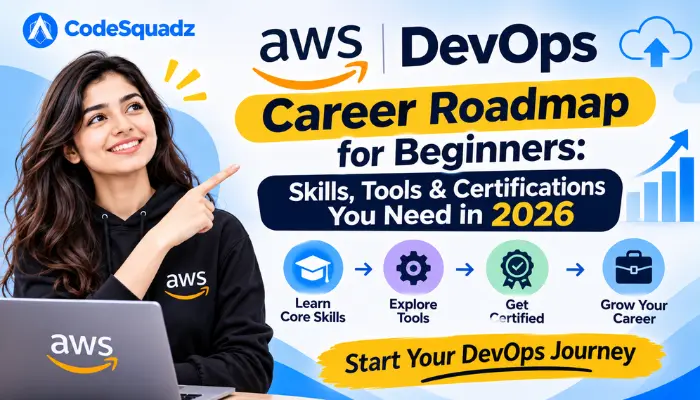
AWS DevOps Career Roadmap for Beginners
If you’re starting from scratch, following a learning sequence can help you avoid confusion. Rather than trying to master every tool together, focus on one skill area at a time.
- Learn the fundamentals: Understand Linux, networking, operating systems, and basic scripting.
- Study AWS basics: Explore EC2, S3, IAM, VPC, and other essential cloud services.
- Practise Git: Learn how to manage code, track changes, and collaborate through repositories.
- Understand CI/CD: Build a basic pipeline using Jenkins and learn how automated testing and deployment work.
- Learn containers: Practise creating and running Docker containers before exploring Kubernetes.
- Explore Terraform: Write configuration files and practise creating cloud infrastructure.
- Build projects: Combine AWS services and DevOps tools to create practical workflows.
- Prepare for certifications and interviews: Revise technical concepts, practise common questions, and explain your projects clearly.
The learning time will depend on your background and daily practice. Beginners should focus on understanding the fundamentals before moving into complex automation and cloud architecture.
AWS Certifications Worth Considering
AWS certifications can help demonstrate your understanding of cloud technologies. They are useful learning milestones, but practical experience is equally important.
Some certifications to explore include:
- AWS Certified Cloud Practitioner: A starting point for understanding AWS cloud concepts, services, and basic terminology.
- AWS Certified Solutions Architect – Associate: Focuses on designing cloud solutions using AWS services.
- AWS Certified Developer – Associate: Covers developing and maintaining applications on AWS.
- AWS Certified SysOps Administrator – Associate: Focuses on operating, monitoring, and managing AWS environments.
You can also explore the AWS Certified DevOps Engineer – Professional certification once you have developed the required AWS and DevOps experience.
Certification requirements and exam details can change, so check the official AWS certification website before planning your exam.
Practical Projects to Build Your AWS DevOps Skills
Reading documentation and watching tutorials can help you understand tools, but practical projects show you how they work together.
Try building projects such as:
- Automated application deployment: Create a simple application and deploy it to an AWS EC2 instance using a CI/CD pipeline.
- Docker-based application: Package a web application into a Docker container and practise running it.
- Infrastructure automation: Use Terraform to create AWS resources such as EC2 instances and networking components.
- Application monitoring: Configure CloudWatch to monitor an AWS resource and create basic alerts.
- Complete CI/CD workflow: Connect Git, Jenkins, Docker, and AWS to automate application deployment.
Start with a small project and document what you build. During interviews, being able to explain the problem, tools, steps, and challenges can help demonstrate your understanding.
Career Opportunities After AWS DevOps Training
After developing the required skills, you can explore different roles depending on your experience and technical strengths.
Common career options include:
- DevOps Engineer: Automates development, testing, and deployment processes.
- AWS Cloud Engineer: Helps manage cloud infrastructure and AWS services.
- Cloud Administrator: Supports cloud resources, access management, and daily operations.
- Build and Release Engineer: Manages software builds, release processes, and deployment workflows.
- Site Reliability Engineer: Focuses on system reliability, availability, and performance.
Your responsibilities will vary by company and role. Some employers expect strong scripting and automation knowledge, while others focus more on AWS infrastructure and operations.
A combination of cloud knowledge, practical projects, troubleshooting ability, and communication skills can help you prepare for these opportunities.
Conclusion
AWS DevOps brings together cloud computing, automation, and software development practices. It helps organisations manage infrastructure, improve deployment processes, and maintain applications more efficiently.
For beginners, the best approach is to build a strong foundation in Linux, networking, Git, and AWS before moving on to tools such as Jenkins, Docker, Kubernetes, and Terraform.
Don’t try to learn everything in a few days. Practise regularly, work on real projects, and understand why each tool is used. As your knowledge grows, you can explore certifications and prepare for relevant job roles.
With consistent learning and practical experience, AWS DevOps training can help you work toward a career in cloud engineering and DevOps.
Frequently Asked Questions
1. What is AWS DevOps?
AWS DevOps combines AWS cloud services with DevOps practices to automate software development, testing, deployment, and infrastructure management. It helps teams deliver applications more efficiently and maintain reliable cloud environments.
2. Is AWS DevOps suitable for beginners?
Yes. Beginners can learn AWS DevOps by starting with Linux, networking, programming basics, and AWS fundamentals. Once these concepts are clear, they can move on to CI/CD, Docker, Jenkins, Terraform, and other tools.
3. Which tools should I learn for AWS DevOps?
Start with Git, Linux, AWS services, and Jenkins. Then explore Docker, Kubernetes, Terraform, and monitoring tools such as CloudWatch. The exact tools required depend on the company and the projects you want to work on.
4. Do I need programming knowledge for AWS DevOps?
You don’t necessarily need to be an advanced programmer, but basic scripting knowledge is useful. Learning Python or Bash can help you automate tasks, manage infrastructure, and work with deployment pipelines.
5. Which AWS certification is best for beginners?
AWS Certified Cloud Practitioner is a useful starting point for people new to cloud computing. After understanding the fundamentals, you can explore associate-level certifications based on your interests and career goals.
6. What jobs can I get after AWS DevOps training?
Depending on your knowledge and practical experience, you can explore roles such as DevOps Engineer, AWS Cloud Engineer, Cloud Administrator, Build and Release Engineer, and Site Reliability Engineer.